Best Motorcycle Helmets 2026
Full-Face, Jet & System Helmet Guide
Find the right helmet by balancing safety, comfort, and style.
This guide is for anyone shopping for a motorcycle helmet in Japan — including overseas buyers importing vehicles or gear. It compares helmet types, safety standards, and popular models. Some product links are affiliate links.
Four Types of Motorcycle Helmets
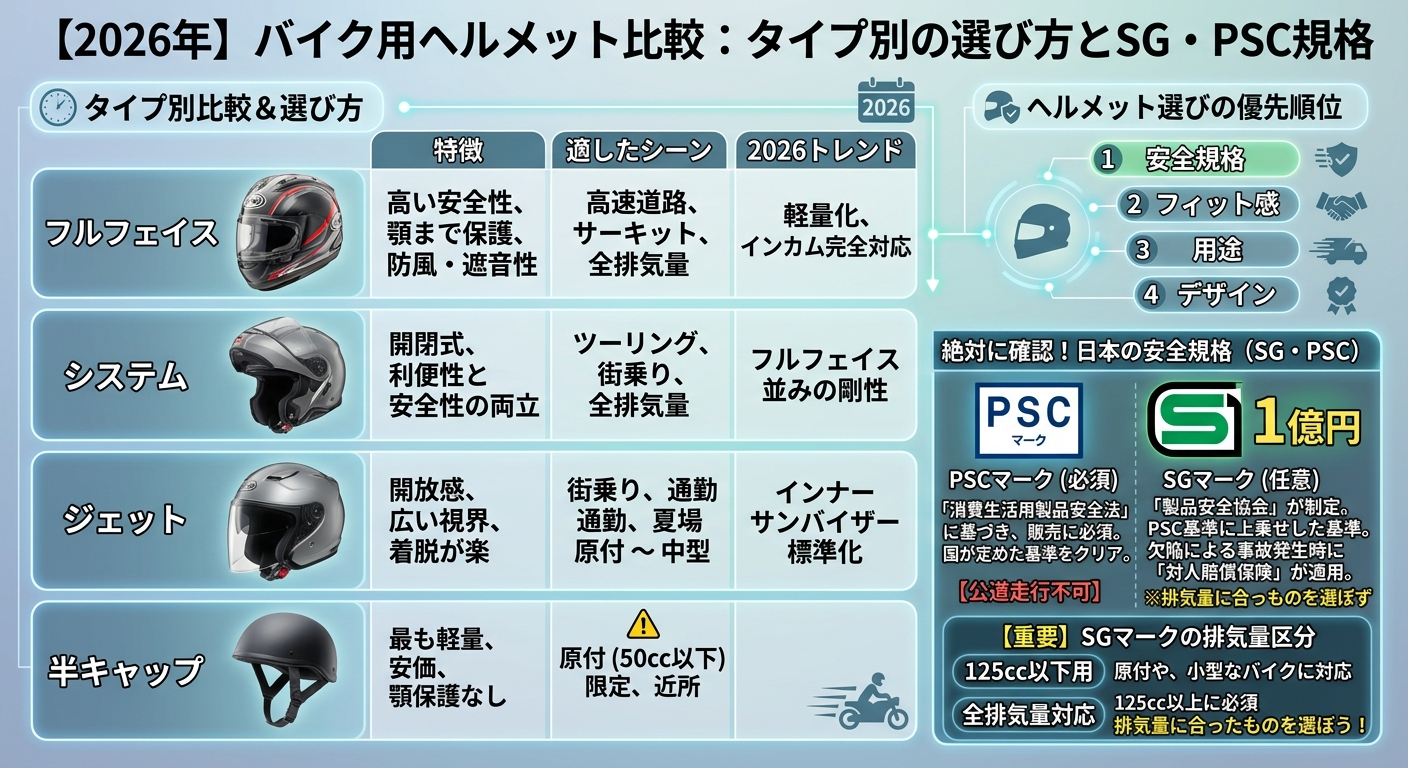
① Full-face
Covers the entire face and is considered the safest type of motorcycle helmet. It offers excellent wind protection and shields your eyes from flying debris. Full-face is the best choice if you ride a large-displacement bike or enjoy sporty riding, since it reduces risk in the event of a crash. It’s also the standard choice for circuit riding.
② Jet helmet
Open at the chin, jet helmets are popular for their style. Many models skip the shield entirely, which pairs well with classic and American-style motorcycles. Shielded versions remain comfortable to ride in the rain.
③ System (modular) helmet
Features a chin bar that flips up, combining full-face safety with jet-helmet openness. This makes it convenient to open up at stoplights or during breaks without removing the helmet entirely.
④ Half helmet
The most compact type, covering only the top of the head. Good for short trips and city riding, but offers less protection than the other types — not ideal for long-distance or expressway riding.
Before You Buy
Avoid used helmets
A helmet’s safe usable life is generally considered to be 3–5 years. With a used helmet, you can’t verify its age or whether it has already absorbed an impact that degraded its protective foam, so buying new is strongly recommended.
Check the ventilation system
Full-face helmets can trap heat during long rides or summer touring, so the quality of the ventilation system significantly affects comfort. Worth checking before you buy.
Popular Models Compared
OGK Kabuto KAMUI-5 (Full-Face, Touring)
OGK Kabuto F-17 (Full-Face, Racing-Derived)
Arai TX-STRADA (Full-Face, Multi-Purpose)
SHOEI Z-8 (Full-Face, Made in Japan)
OGK Kabuto RYUKI (System Helmet, Lightweight)
Comparison Table
| Model | Type | Highlights | Approx. Price | Best For |
|---|---|---|---|---|
| OGK Kabuto KAMUI-5 | Full-Face | Touring / inner sun visor | ¥34,180+ | First full-face helmet |
| OGK Kabuto F-17 | Full-Face | Aero-focused / Mips | ¥49,750 | Sport-oriented riders |
| Arai TX-STRADA | Full-Face | Multi-purpose / VAS shield | ¥74,800 | Varied riding conditions |
| SHOEI Z-8 | Full-Face | Made in Japan / high impact absorption | ¥82,800 | Quality & design focus |
| OGK Kabuto RYUKI | System Helmet | Lightweight / flip-up | ¥33,500 | Convenience & comfort |
FAQ
Q. Which is safer, a jet helmet or a full-face?
Full-face helmets, which cover the entire face, offer higher safety. If minimizing crash risk is your priority, full-face or system helmets are the better choice. Jet helmets remain an option if you value style or open-air feel, but full-face is better suited to high-speed or long-distance riding.
Q. Are cheap helmets still safe?
A PSC mark confirms a helmet meets the minimum legal standard for road use, but for unfamiliar budget brands, always double-check whether they carry recognized safety certifications. Major domestic brands like SHOEI, Arai, and OGK Kabuto are almost always compliant with SG and PSC standards.
Q. When should I replace my helmet?
The generally accepted safe lifespan is 3–5 years. If your helmet has taken an impact from a fall, replace it even if it looks undamaged from the outside — the internal impact-absorbing foam may have already degraded.
Choose based on how you ride
Prioritize full-face if safety comes first, or a system helmet if you want convenience. Balance your riding style against your budget.
Browse ETC device comparisons