Category: Uncategorized

  • [2026] Car Fridge ComparisonHow to Choose for Car Camping

    [2026] Car Fridge ComparisonHow to Choose for Car Camping

    [2026] Car Fridge Comparison: How to Choose for Car Camping | JDM Garage Navi
    STAY
    COOL!
    🚗 CAR GEAR COMPARISON

    [2026] Car Fridge Comparison
    How to Choose for Car Camping

    Drive. Park. Chill. Find the cooling partner for your next trip!

    AD

    This article summarizes buying tips and a comparison of popular models for anyone considering a car (portable) fridge. Some product links are affiliate links. Products are sold in Japan; check availability and shipping before ordering from overseas.

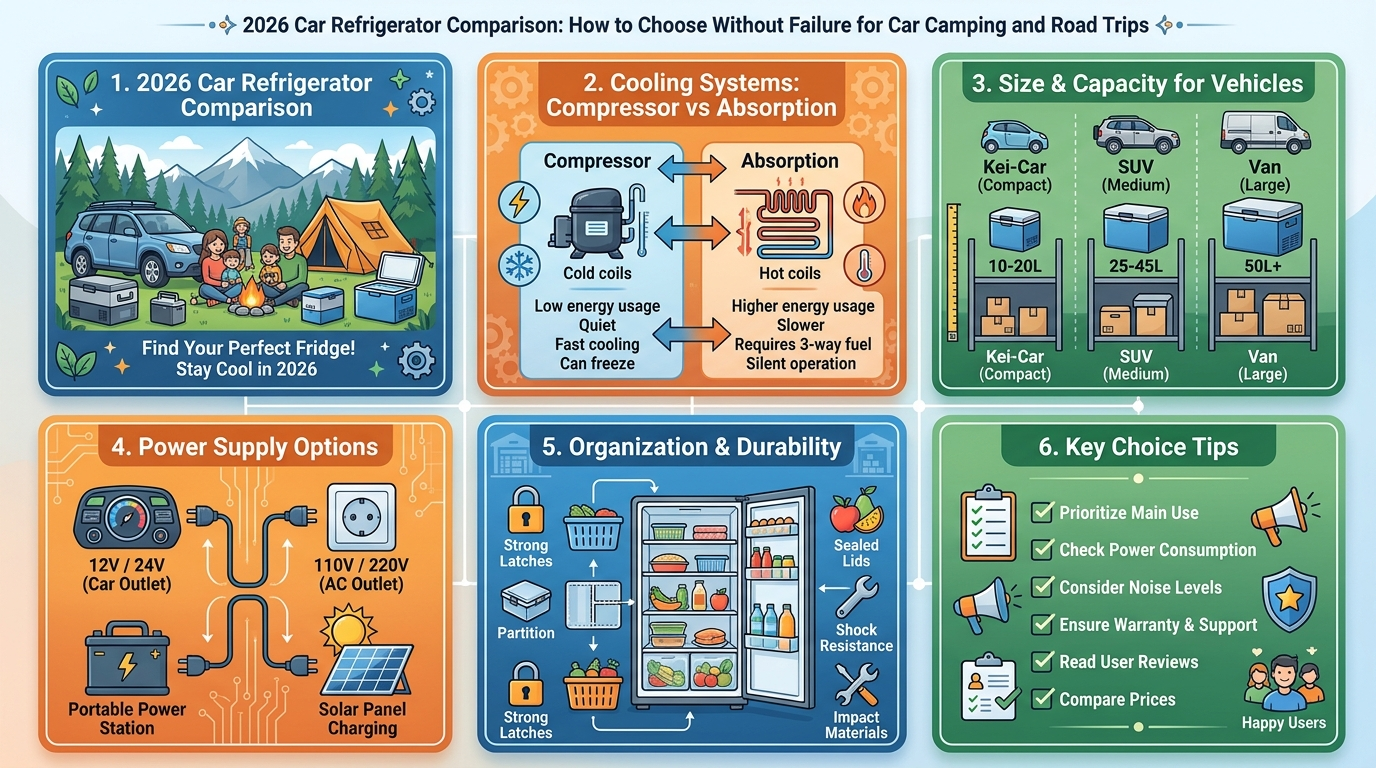
    3 Gears for Choosing

    1

    Cooling type: compressor or Peltier?

    Choose a compressor model if you want sub-zero cooling and freezing; a light, cheap Peltier model is fine for chilling drinks on short drives.

    ❄ Compressor Same principle as a home fridge.
    • Many models can freeze
    • Stable cooling even in a hot summer car
    • Pricier and somewhat heavier
    🔥 Peltier Small electronic cooling type.
    • Light, quiet and cheap
    • Typically about 20°C below ambient
    • Not suited to long midsummer use or freezing
    2

    Capacity and placement

    As a guide, 15–20L for day trips and 30L or more for overnight car camping or families. Check that it fits at the rear footwell or in the cargo area. Larger units are heavier, so loading and unloading matters too.

    3

    Power: DC 12V, AC and batteries

    Most run from the car’s cigarette socket (DC 12V), but AC support is handy for pre-cooling at home. If you will use it with the engine off, check for portable power station or dedicated battery support. Auto shutoff on low voltage helps protect against a dead car battery.

    Watch out for a dead battery: Running a car fridge with the engine off can drain the car battery. For long overnight stays, consider using a portable power station and keeping a jump starter on hand.

    Popular Models Compared

    NO.1

    Iris Ohyama Portable Fridge-Freezer 20L IPD-2A

    Balanced all-rounder
    Price: ¥22,198 (tax incl., free shipping) (as of 2026/10/27)
    Capacity
    Capacity: approx. 20L / Temp: −20 to 20°C / Power: AC (household) and DC 12/24V
    Auto shutoff on low voltage / USB charging port. Freezer-capable, great from day trips to one-night car camping. (The Amazon listing is model IPD-3A-B — please check specs before buying.)
    NO.2

    Yamazen Portable Cooler-Warmer YFR-DC350 (35L)

    Large capacity / family
    Price: from ¥29,800 (tax incl., free shipping) — lowest price across sizes; check the 35L price on the sales page (as of 2026/10/27)
    Capacity
    Capacity: 35L / Temp: −18 to 60°C (freezing to warming) / Power: AC, DC, battery pack (sold separately), solar panel compatible
    Refrigerates, freezes and keeps food warm in one unit. Available in 9L / 25L / 35L; the 35L is featured here. Ideal for family camping and multi-night trips.
    NO.3

    Makita Cordless Cooler-Warmer CW001GZO

    Cordless / hot & cold
    Price: ¥60,137 (tax incl., free shipping) (as of 2026/10/27) *Unit only — battery and charger sold separately
    Capacity
    Capacity: 20L / Temp: cooling −18 to 10°C, warming 30 to 60°C / Power: AC, DC 12/24V, Makita battery (36/18V)
    Runs on Makita batteries, so it works even away from the car. IPX4-equivalent water resistance. The linked model is the unit-only olive version — you need to buy a Makita battery and charger separately.
    NO.4

    Terzo Excel Cool Multi 14L EA-CB6

    Compact / easy
    Price: ¥5,980 (tax incl.) (as of 2026/10/27, Amazon)
    Capacity
    Capacity: 14L / Cooling: up to 20°C below ambient, warming up to 55°C (Peltier type) / Power: DC 12V (car only)
    At 3.5kg it fits at your feet or in the trunk. It cannot freeze, so it suits short drives where you just want cold drinks.

    Spec Comparison

    ProductCapacityTemperaturePowerPriceBest For
    Iris Ohyama IPD-2Aapprox. 20L−20 to 20°CAC / DC 12/24V¥22,198Day trips to 1 night, freezing
    Yamazen YFR-DC35035L−18 to 60°CAC / DC / battery / solarfrom ¥29,800Families, multi-night camping
    Makita CW001GZO20L−18 to 10°C (warming 30–60°C)AC / DC 12/24V / Makita battery¥60,137 (unit only)Cordless, hot & cold
    Terzo EA-CB614Lambient −20°C / warming to 55°CDC 12V only¥5,980Short drives, easy use

    FAQ

    Can I use a car fridge with the engine off?

    Running from the cigarette socket can drain the car battery. Choose a model with low-voltage auto shutoff, or one that supports a portable power station or dedicated battery.

    How is it different from a cooler box?

    A cooler box needs ice packs and warms up over time. A car fridge keeps cooling electrically, so food and drinks stay at a steady temperature.

    Should I pre-cool it?

    Yes. With an AC-capable model, pre-cool at home before leaving to reduce power use and cooling time in the car. Pre-chilling the contents helps too.

    Pick your partner and drive free!

    Check capacity, power and temperature range against your destination and group size before buying.

    Also see: Jump Starter Comparison
    Related Articles

    © jdm-garage-navi.com | This article contains affiliate advertising.

  • Best Motorcycle Helmets 2026Full-Face, Jet & System Helmet Guide

    Best Motorcycle Helmets 2026Full-Face, Jet & System Helmet Guide

    Best Motorcycle Helmets 2026 | Full-Face, Jet & System Helmet Guide (JDM Garage Navi)
    Motorcycle Gear Comparison

    Best Motorcycle Helmets 2026
    Full-Face, Jet & System Helmet Guide

    Find the right helmet by balancing safety, comfort, and style.

    AD

    This guide is for anyone shopping for a motorcycle helmet in Japan — including overseas buyers importing vehicles or gear. It compares helmet types, safety standards, and popular models. Some product links are affiliate links.

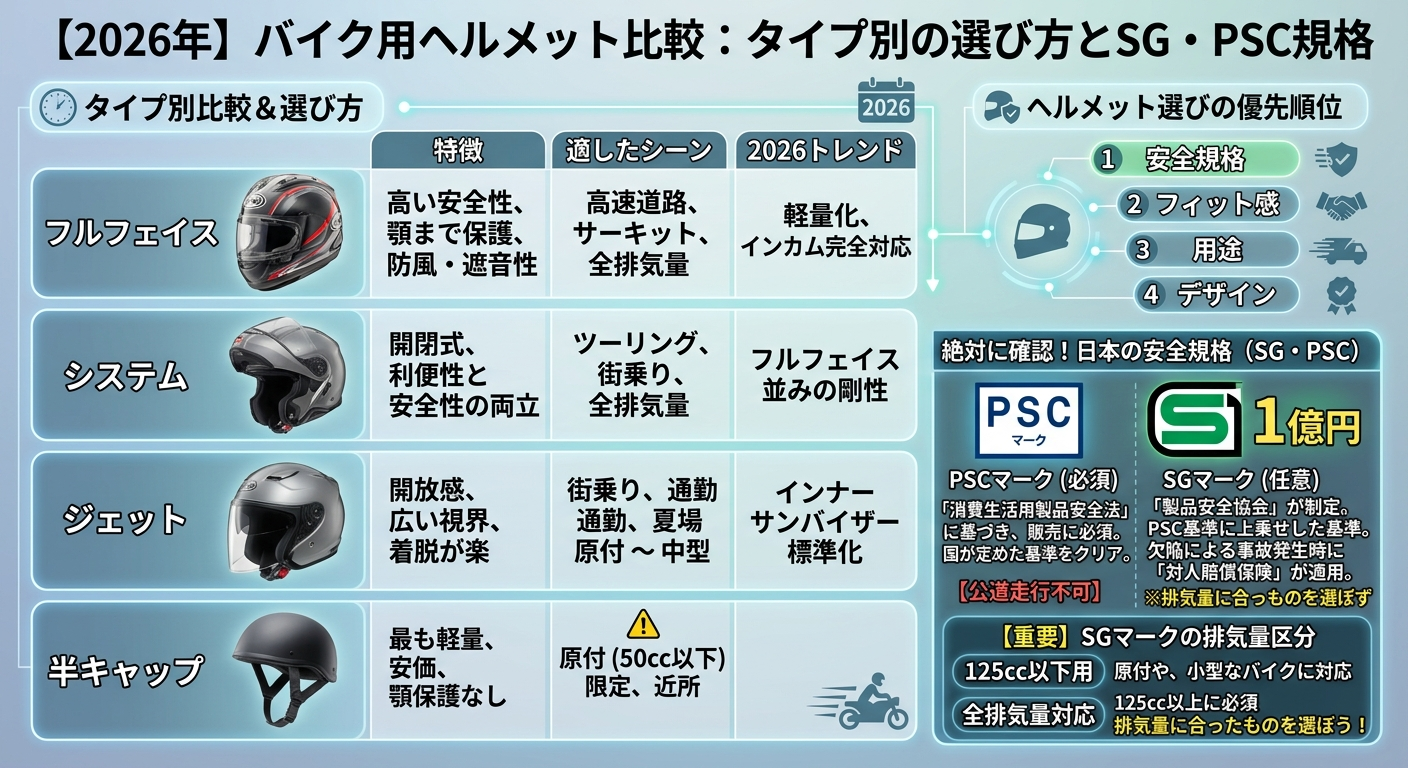
    Four Types of Motorcycle Helmets

    ① Full-face

    Covers the entire face and is considered the safest type of motorcycle helmet. It offers excellent wind protection and shields your eyes from flying debris. Full-face is the best choice if you ride a large-displacement bike or enjoy sporty riding, since it reduces risk in the event of a crash. It’s also the standard choice for circuit riding.

    ② Jet helmet

    Open at the chin, jet helmets are popular for their style. Many models skip the shield entirely, which pairs well with classic and American-style motorcycles. Shielded versions remain comfortable to ride in the rain.

    ③ System (modular) helmet

    Features a chin bar that flips up, combining full-face safety with jet-helmet openness. This makes it convenient to open up at stoplights or during breaks without removing the helmet entirely.

    ④ Half helmet

    The most compact type, covering only the top of the head. Good for short trips and city riding, but offers less protection than the other types — not ideal for long-distance or expressway riding.

    Reading safety standards: A “PSC mark” is legally required to sell a helmet for road use in Japan — without it, a helmet is decorative only and not legal for riding. An “SG mark” indicates the product meets additional safety criteria and comes with product-liability insurance coverage in case of a defect-related injury. Helmets from major domestic brands like SHOEI, Arai, and OGK Kabuto are almost always compliant with both. If you ride expressways often or want extra peace of mind, look for SNELL or ECE certification as well.

    Before You Buy

    Avoid used helmets

    A helmet’s safe usable life is generally considered to be 3–5 years. With a used helmet, you can’t verify its age or whether it has already absorbed an impact that degraded its protective foam, so buying new is strongly recommended.

    Check the ventilation system

    Full-face helmets can trap heat during long rides or summer touring, so the quality of the ventilation system significantly affects comfort. Worth checking before you buy.

    Popular Models Compared

    OGK Kabuto KAMUI-5 (Full-Face, Touring)

    Approx. ¥34,180+
    Built-in inner sun visor / touring-focused full-face designed for comfort and ease of use
    An accessible first full-face helmet, suited for everything from city riding to long tours.

    OGK Kabuto F-17 (Full-Face, Racing-Derived)

    Approx. ¥49,750
    Aerodynamics-focused design / advanced composite shell material “A.C.T.-2” / Mips® safety system
    For riders who prioritize high-speed stability and safety with a sport-riding focus.

    Arai TX-STRADA (Full-Face, Multi-Purpose)

    Approx. ¥74,800
    Handles on-road and off-road riding / VAS shield system / SNELL and JIS certified
    For riders who want one helmet to handle a wide range of touring situations.

    SHOEI Z-8 (Full-Face, Made in Japan)

    Approx. ¥82,800
    Made in Japan / SHOEI’s signature high-grade impact absorption
    For riders who want the best balance of quality, safety, and design.

    OGK Kabuto RYUKI (System Helmet, Lightweight)

    Approx. ¥33,500
    System (modular) helmet / lightweight construction / JIS certified
    For riders who want the convenience of a flip-up chin bar without extra weight.

    Comparison Table

    ModelTypeHighlightsApprox. PriceBest For
    OGK Kabuto KAMUI-5Full-FaceTouring / inner sun visor¥34,180+First full-face helmet
    OGK Kabuto F-17Full-FaceAero-focused / Mips¥49,750Sport-oriented riders
    Arai TX-STRADAFull-FaceMulti-purpose / VAS shield¥74,800Varied riding conditions
    SHOEI Z-8Full-FaceMade in Japan / high impact absorption¥82,800Quality & design focus
    OGK Kabuto RYUKISystem HelmetLightweight / flip-up¥33,500Convenience & comfort

    FAQ

    Q. Which is safer, a jet helmet or a full-face?

    Full-face helmets, which cover the entire face, offer higher safety. If minimizing crash risk is your priority, full-face or system helmets are the better choice. Jet helmets remain an option if you value style or open-air feel, but full-face is better suited to high-speed or long-distance riding.

    Q. Are cheap helmets still safe?

    A PSC mark confirms a helmet meets the minimum legal standard for road use, but for unfamiliar budget brands, always double-check whether they carry recognized safety certifications. Major domestic brands like SHOEI, Arai, and OGK Kabuto are almost always compliant with SG and PSC standards.

    Q. When should I replace my helmet?

    The generally accepted safe lifespan is 3–5 years. If your helmet has taken an impact from a fall, replace it even if it looks undamaged from the outside — the internal impact-absorbing foam may have already degraded.

    Choose based on how you ride

    Prioritize full-face if safety comes first, or a system helmet if you want convenience. Balance your riding style against your budget.

    Browse ETC device comparisons

    Related Articles

    © jdm-garage-navi.com | This article contains affiliate advertising.