Author: jdmgarage_admin

  • Best Impact Drivers 2026Pro & DIY Buying Guide

    Best Impact Drivers 2026Pro & DIY Buying Guide

    Best Impact Drivers 2026 | Pro & DIY Buying Guide (JDM Garage Navi)
    Work & DIY Tools Comparison

    Best Impact Drivers 2026
    Pro & DIY Buying Guide

    Find the right driver by voltage, torque, and hammer mechanism.

    AD

    This guide is for anyone shopping for an impact driver — from DIY beginners to working pros. It compares what to look for and popular Japanese-brand models. Some product links are affiliate links.

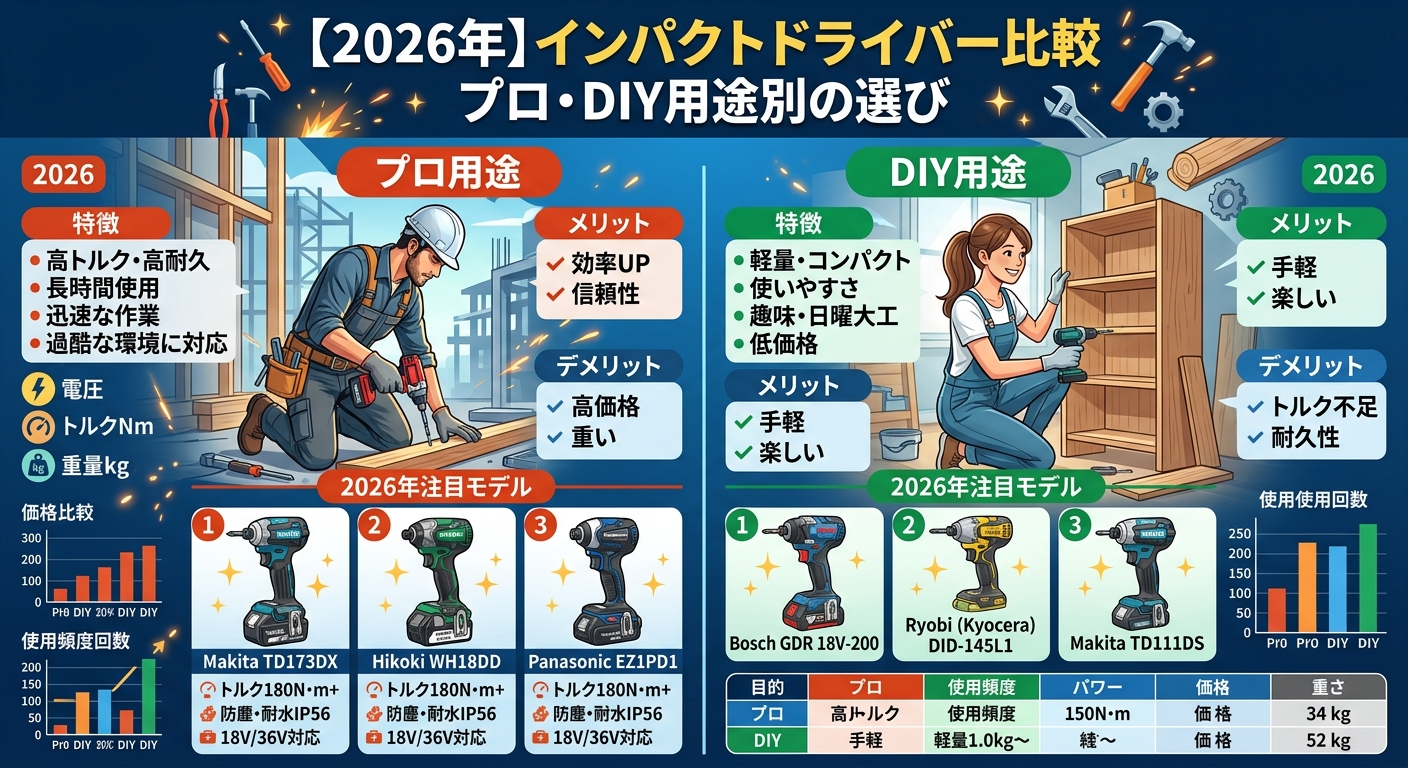
    Three Things to Check Before Buying

    ① Voltage and battery capacity

    10.8V-class drivers are lightweight and suited to everyday DIY tasks like assembling furniture, while 18V, 36V, and 40V-class models deliver more power for professional job sites and extended continuous use. Choosing a model within a battery-sharing lineup (so it uses the same battery as your circular saw or grinder) can save money as you build out a tool collection.

    ② Maximum fastening torque

    Higher torque (N·m) means the driver can handle thicker screws and harder materials. For DIY and furniture assembly, 100–135N·m is generally plenty, while professional uses like interior and electrical work tend to favor models around 200N·m.

    ③ Hammer mechanism and mode switching

    Beyond the traditional two-point hammer strike, some newer models use a triple-hammer mechanism that reduces vibration and screw cam-out. Mode-switching (strong / weak / fine-screw) helps the driver adapt to different materials and screw types.

    Using in an apartment: Impact drivers produce a distinctive striking noise. If you live in an apartment building, choosing a model designed with a quieter strike can help avoid noise complaints from neighbors.

    Popular Models Compared

    DCM ID-180D (18V, Entry-Level)

    Approx. ¥15,000 (used unit pricing may vary)
    Brushless motor / 190N·m max torque / 3-mode switching / battery shared across the same brand’s circular saws and grinders
    Good for anyone wanting brushless performance on a budget, or buying their first driver.

    Makita TD173DZ (Tool Only)

    Approx. ¥18,370+ (tool body only)
    From Makita, one of Japan’s top-selling tool brands / well-regarded for both drilling and screw-driving / compatible with BL1860B battery and DC18RF charger
    A go-to standard for anyone looking for a dependable first impact driver.

    HiKOKI WH18DC (Cordless Impact Driver)

    Approx. ¥16,800 (display unit pricing may vary)
    Kit includes battery, charger, and case / HiKOKI’s cooling fin design efficiently dissipates heat inside the oil-pulse mechanism
    For pros and serious hobbyists who need a driver that holds up under continuous use.

    Makita TD002GRDX (40Vmax, LED Light)

    Approx. ¥55,790+
    Includes two 40Vmax BL4025 batteries, DC40RA charger, and case / built-in LED light / high-output professional model
    For pros who prioritize power and battery life.

    HiKOKI WH36DD (Multi Volt 36V, Triple Hammer)

    Approx. ¥43,990
    200N·m max fastening torque / triple-hammer mechanism (3-point strike) / fine-screw mode available via Bluetooth battery app (requires activation) / includes two BSL36A18BX batteries and charger
    A high-function model favored by pros in facilities, electrical, and interior work.

    Comparison Table

    ModelVoltageMax TorqueApprox. PriceBest For
    DCM ID-180D18V190N·m~¥15,000 (used)Entry-level, budget-conscious
    Makita TD173DZ18VTBC¥18,370+Reliable go-to model
    HiKOKI WH18DC18VTBC¥16,800 (display unit)Continuous work, pros
    Makita TD002GRDX40VmaxTBC¥55,790+High output, pros
    HiKOKI WH36DD36V200N·m¥43,990Facilities/electrical/interior pros

    FAQ

    Q. What voltage do I need for DIY use?

    For general DIY tasks like assembling furniture or mounting shelves, a 10.8V–18V model is plenty. If you frequently drill wood or drive thick screws, consider stepping up to 18V or higher.

    Q. Should I buy tool-only or a full battery kit?

    If you already own batteries from the same brand, buying tool-only saves money. If this is your first tool from that lineup, a starter kit with battery, charger, and case is usually better value overall.

    Q. Makita or HiKOKI — which should I choose?

    Both are top-tier Japanese brands with no major difference in performance. If you already have batteries from one brand, sticking with it is the practical choice. If you’re starting fresh, either is a safe pick — go with whichever price point or lineup you prefer.

    Match the tool to your use case and budget

    10.8V–18V covers most DIY needs; 36V and up is built for professional use. Sticking to one battery-sharing lineup makes it easier to build out your tool collection.

    Browse motorcycle helmet comparisons
    Related Articles

    © jdm-garage-navi.com | This article contains affiliate advertising.

  • Best Motorcycle Helmets 2026Full-Face, Jet & System Helmet Guide

    Best Motorcycle Helmets 2026Full-Face, Jet & System Helmet Guide

    Best Motorcycle Helmets 2026 | Full-Face, Jet & System Helmet Guide (JDM Garage Navi)
    Motorcycle Gear Comparison

    Best Motorcycle Helmets 2026
    Full-Face, Jet & System Helmet Guide

    Find the right helmet by balancing safety, comfort, and style.

    AD

    This guide is for anyone shopping for a motorcycle helmet in Japan — including overseas buyers importing vehicles or gear. It compares helmet types, safety standards, and popular models. Some product links are affiliate links.

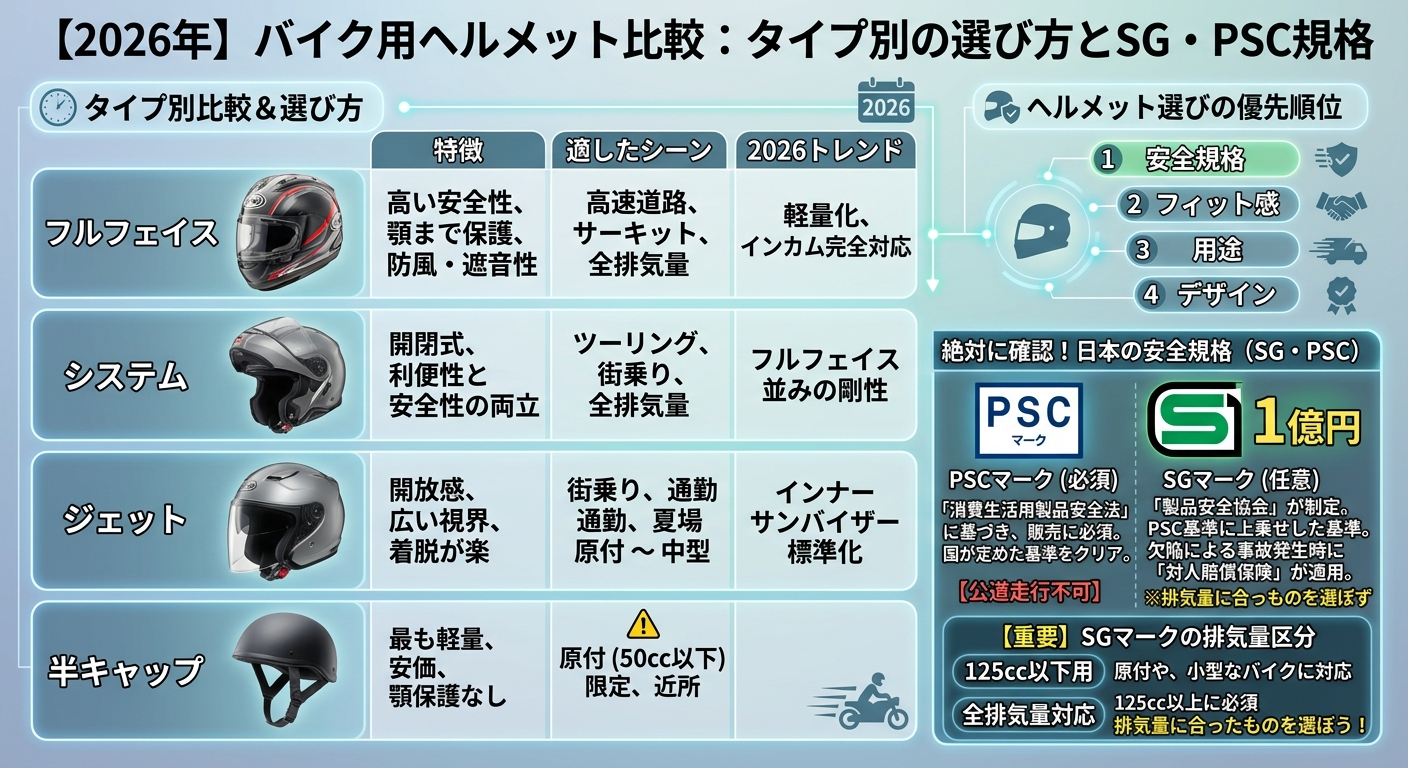
    Four Types of Motorcycle Helmets

    ① Full-face

    Covers the entire face and is considered the safest type of motorcycle helmet. It offers excellent wind protection and shields your eyes from flying debris. Full-face is the best choice if you ride a large-displacement bike or enjoy sporty riding, since it reduces risk in the event of a crash. It’s also the standard choice for circuit riding.

    ② Jet helmet

    Open at the chin, jet helmets are popular for their style. Many models skip the shield entirely, which pairs well with classic and American-style motorcycles. Shielded versions remain comfortable to ride in the rain.

    ③ System (modular) helmet

    Features a chin bar that flips up, combining full-face safety with jet-helmet openness. This makes it convenient to open up at stoplights or during breaks without removing the helmet entirely.

    ④ Half helmet

    The most compact type, covering only the top of the head. Good for short trips and city riding, but offers less protection than the other types — not ideal for long-distance or expressway riding.

    Reading safety standards: A “PSC mark” is legally required to sell a helmet for road use in Japan — without it, a helmet is decorative only and not legal for riding. An “SG mark” indicates the product meets additional safety criteria and comes with product-liability insurance coverage in case of a defect-related injury. Helmets from major domestic brands like SHOEI, Arai, and OGK Kabuto are almost always compliant with both. If you ride expressways often or want extra peace of mind, look for SNELL or ECE certification as well.

    Before You Buy

    Avoid used helmets

    A helmet’s safe usable life is generally considered to be 3–5 years. With a used helmet, you can’t verify its age or whether it has already absorbed an impact that degraded its protective foam, so buying new is strongly recommended.

    Check the ventilation system

    Full-face helmets can trap heat during long rides or summer touring, so the quality of the ventilation system significantly affects comfort. Worth checking before you buy.

    Popular Models Compared

    OGK Kabuto KAMUI-5 (Full-Face, Touring)

    Approx. ¥34,180+
    Built-in inner sun visor / touring-focused full-face designed for comfort and ease of use
    An accessible first full-face helmet, suited for everything from city riding to long tours.

    OGK Kabuto F-17 (Full-Face, Racing-Derived)

    Approx. ¥49,750
    Aerodynamics-focused design / advanced composite shell material “A.C.T.-2” / Mips® safety system
    For riders who prioritize high-speed stability and safety with a sport-riding focus.

    Arai TX-STRADA (Full-Face, Multi-Purpose)

    Approx. ¥74,800
    Handles on-road and off-road riding / VAS shield system / SNELL and JIS certified
    For riders who want one helmet to handle a wide range of touring situations.

    SHOEI Z-8 (Full-Face, Made in Japan)

    Approx. ¥82,800
    Made in Japan / SHOEI’s signature high-grade impact absorption
    For riders who want the best balance of quality, safety, and design.

    OGK Kabuto RYUKI (System Helmet, Lightweight)

    Approx. ¥33,500
    System (modular) helmet / lightweight construction / JIS certified
    For riders who want the convenience of a flip-up chin bar without extra weight.

    Comparison Table

    ModelTypeHighlightsApprox. PriceBest For
    OGK Kabuto KAMUI-5Full-FaceTouring / inner sun visor¥34,180+First full-face helmet
    OGK Kabuto F-17Full-FaceAero-focused / Mips¥49,750Sport-oriented riders
    Arai TX-STRADAFull-FaceMulti-purpose / VAS shield¥74,800Varied riding conditions
    SHOEI Z-8Full-FaceMade in Japan / high impact absorption¥82,800Quality & design focus
    OGK Kabuto RYUKISystem HelmetLightweight / flip-up¥33,500Convenience & comfort

    FAQ

    Q. Which is safer, a jet helmet or a full-face?

    Full-face helmets, which cover the entire face, offer higher safety. If minimizing crash risk is your priority, full-face or system helmets are the better choice. Jet helmets remain an option if you value style or open-air feel, but full-face is better suited to high-speed or long-distance riding.

    Q. Are cheap helmets still safe?

    A PSC mark confirms a helmet meets the minimum legal standard for road use, but for unfamiliar budget brands, always double-check whether they carry recognized safety certifications. Major domestic brands like SHOEI, Arai, and OGK Kabuto are almost always compliant with SG and PSC standards.

    Q. When should I replace my helmet?

    The generally accepted safe lifespan is 3–5 years. If your helmet has taken an impact from a fall, replace it even if it looks undamaged from the outside — the internal impact-absorbing foam may have already degraded.

    Choose based on how you ride

    Prioritize full-face if safety comes first, or a system helmet if you want convenience. Balance your riding style against your budget.

    Browse ETC device comparisons

    Related Articles

    © jdm-garage-navi.com | This article contains affiliate advertising.

  • Best ETC Onboard Units 2026 | Japan Expressway Toll Device Guide

    Best ETC Onboard Units 2026 | Japan Expressway Toll Device Guide

    Best ETC Onboard Units 2026 | Japan Expressway Toll Device Guide (JDM Garage Navi)
    Car Accessories Comparison

    Best ETC Onboard Units 2026
    Japan Expressway Toll Device Guide

    The essential device for non-stop tolling on Japanese expressways. Compare types and popular models below.

    AD

    This guide is for anyone shopping for an ETC (Electronic Toll Collection) device for driving in Japan — including overseas buyers importing or shipping vehicles. It compares device types and popular models. Some product links are affiliate links.

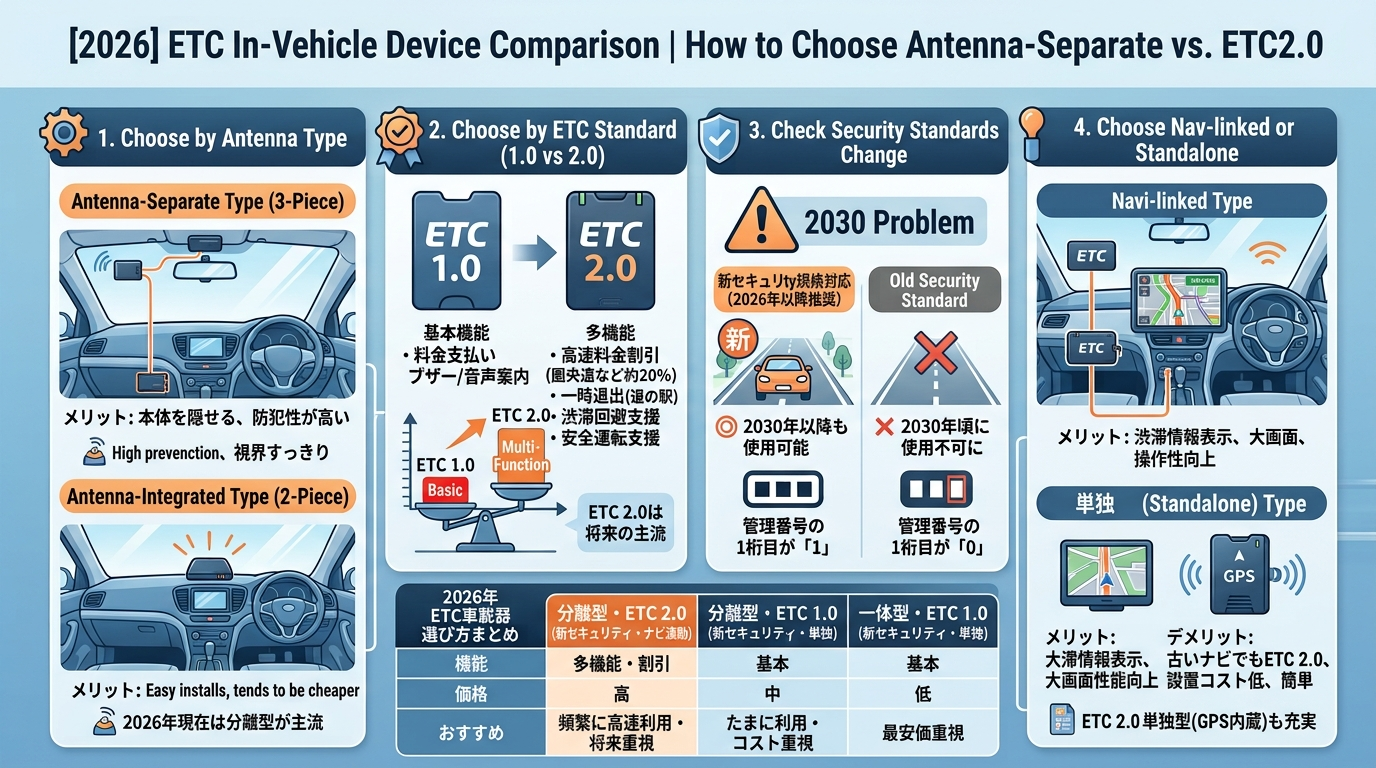
    Three Types of ETC Devices

    ① Antenna-integrated (2-piece) type

    The unit and antenna are combined into a single piece. These are typically mounted on the windshield within easy reach, making card insertion and removal simple. They’re generally more affordable than other types, making them a good choice for budget-conscious drivers who don’t mind handling the card directly.

    ② Antenna-separate (3-piece) type

    The main unit and antenna are installed separately. The antenna goes somewhere with good reception (like the upper windshield), while the main unit can be tucked away in the glovebox or footwell — keeping the cabin tidy and adding a layer of theft deterrence. This flexibility comes at a slightly higher price than the integrated type.

    ③ Built-in type

    The ETC unit is factory-integrated into the vehicle, usually as a dealer-installed option on new cars. Since nothing is visible from outside, it offers the best security and space efficiency, but retrofitting is only available on limited vehicle models.

    About ETC2.0: In addition to standard tolling, ETC2.0 devices receive wide-area traffic information, congestion avoidance support, and safe-driving assistance broadcast from roadside units. It’s worth the upgrade if you drive expressways frequently or want access to certain route discounts. Occasional expressway users are usually fine with standard ETC.

    What to Know Before Buying

    Setup fee required separately

    An ETC device cannot be used right out of the box — it requires “setup,” a legally mandated procedure that registers your vehicle information and can only be performed at a certified installer. This typically costs an additional ¥2,500–¥3,500. Some listings include setup in the price, others don’t, so check carefully before buying.

    New security standard compliance

    Due to a security standard transition, devices built to the old “spurious” standard are expected to stop working sometime around 2030. If you’re buying new, choosing a model compliant with the current security standard will keep you covered for the foreseeable future.

    Popular Models Compared

    Panasonic CY-ET926D (Antenna-Separate)

    Approx. ¥7,500
    New security standard compliant / built-in-speaker antenna with up to 100 stored trip records / works on both 12V and 24V
    Good for buyers who want a tidy cabin and better theft resistance.

    ASTEMO HF-EV715 (Antenna-Separate)

    Approx. ¥7,590
    Japanese voice guidance and melody notifications / new security standard compliant / setup included
    A solid budget pick that still covers the essentials.

    Denso DIU-A210 (ETC2.0, Antenna-Separate)

    Approx. ¥17,800
    ETC2.0 compatible / antenna-separate with built-in speaker / GPS-enabled voice announcements / 5-level voice volume adjustment / works on both 12V and 24V
    Best for frequent expressway drivers who want congestion avoidance support.

    Panasonic CY-ET2620GD (ETC2.0, Antenna-Integrated)

    Approx. ¥20,200
    ETC2.0 compatible / antenna-integrated / built-in GPS / new security standard compliant
    For buyers who want both easy installation and ETC2.0 features.

    Comparison Table

    ModelTypeETC2.0Approx. PriceBest For
    Panasonic CY-ET926DAntenna-SeparateNo¥7,500Security & tidy install
    ASTEMO HF-EV715Antenna-SeparateNo¥7,590Budget-conscious buyers
    Denso DIU-A210Antenna-SeparateYes¥17,800Frequent expressway drivers
    Panasonic CY-ET2620GDAntenna-IntegratedYes¥20,200Easy installation

    FAQ

    Q. Is ETC2.0 necessary?

    Not necessarily. If you drive expressways often and want to take advantage of congestion avoidance support or route-specific discounts, ETC2.0 is worth it. Occasional users are usually fine with standard ETC.

    Q. Can I do the setup myself?

    No — setup is a legally regulated procedure that can only be performed at a certified installer. Check whether the listing includes setup or requires a separate appointment before you buy.

    Q. How long will my current ETC device keep working?

    Due to the security standard transition, devices built to the old “spurious” standard are expected to stop working around 2030. Check your device’s model number with the manufacturer, or verify your device management number, to see if it’s affected.

    Choose based on how often you drive

    Frequent expressway users benefit most from ETC2.0; occasional drivers can save money with a standard model. Also factor in how much installation flexibility you need.

    Browse dash cam comparisons

    Related Articles

    © jdm-garage-navi.com | This article contains affiliate advertising.

  • 【2026年】ドライブレコーダー比較|前後2カメラで後悔しない選び方

    【2026年】ドライブレコーダー比較|前後2カメラで後悔しない選び方

    【2026年】ドライブレコーダー比較|前後2カメラで後悔しない選び方
    EN
    カー用品比較

    【2026年】ドライブレコーダー比較
    前後2カメラで後悔しない選び方

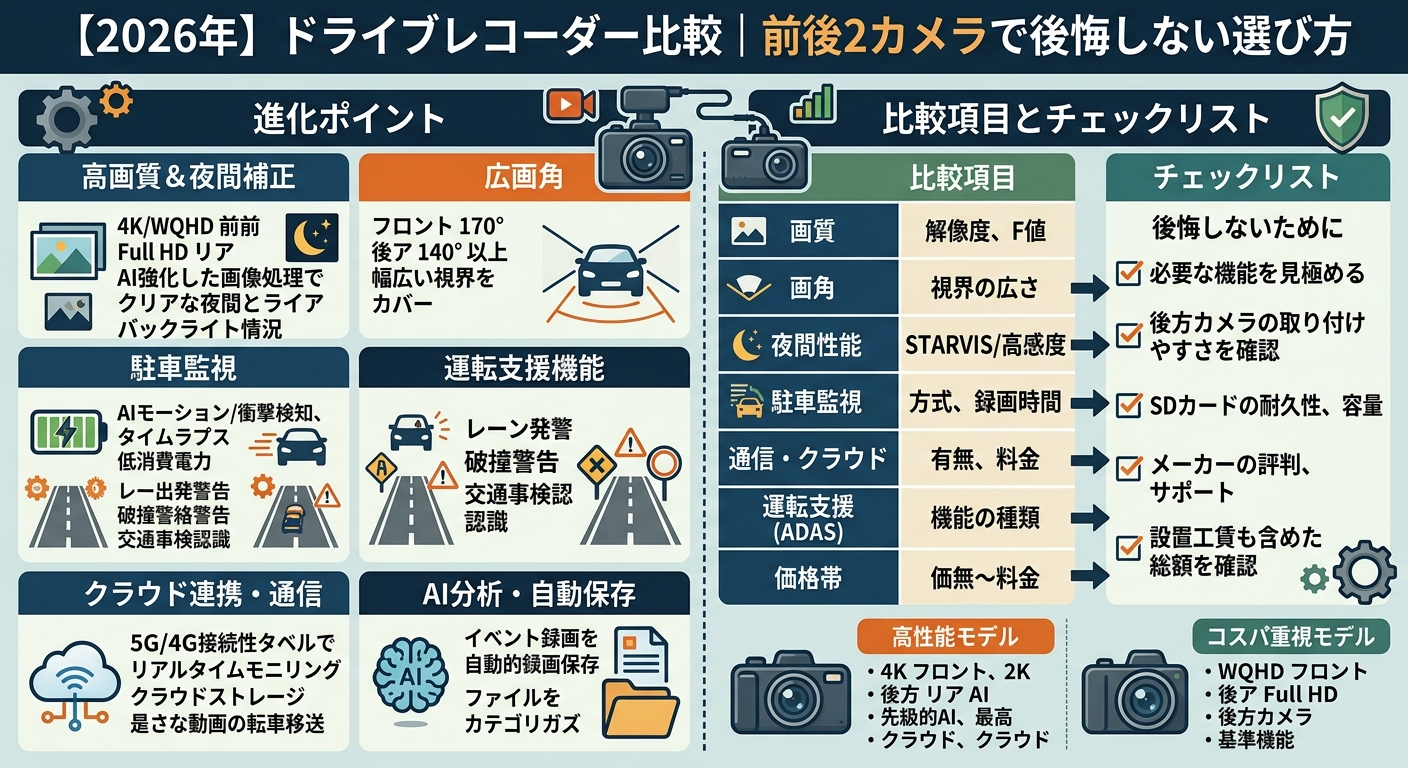
    事故・あおり運転・駐車中トラブルへの備えに。タイプ別の違いと人気モデルを解説します。

    PR

    本記事はドライブレコーダーの購入を検討している方向けに、タイプ別の特徴と選び方、人気モデルの比較情報をまとめたものです。一部の商品リンクはアフィリエイトプログラムを利用しています。

    ドライブレコーダーの3つのタイプ

    ① フロント(前方)タイプ

    前方のみを記録するシンプルなタイプです。事故の多くは前方で発生するため、最低限の備えとしては前方カメラのみでも一定の証拠能力があります。価格が手頃で配線もシンプルなため、初めて取り付ける方にも向いています。

    ② 前後2カメラタイプ

    フロントとリアの両方に記録用カメラを搭載するタイプです。後方からの追突やあおり運転など、前方カメラだけでは記録できないトラブルにも対応できます。現在最も主流のタイプで、多くのメーカーから選択肢があります。フロントからリアまでの配線が必要なため、取り付け工賃は1カメラタイプよりやや高くなる傾向があります。

    ③ 360度・ミラー型タイプ

    前席付近に設置し、車内越しに全方位を撮影する360度タイプは、幅寄せやすり抜けなど側面のトラブルも記録できるのが特徴です。ただし後方の映像は不鮮明になりやすいため、後方カメラを追加できるモデルを選ぶと安心です。デジタルミラー型はルームミラーを置き換える形で設置し、視認性を保ちながら記録できる点が支持されています。

    選び方のポイント: 夜間走行が多い方は「STARVIS 2」などの高感度センサー搭載モデル、駐車場所に不安がある方は駐車監視機能(Gセンサー・タイムラプス録画)付きのモデルを選ぶと安心です。

    人気モデル比較

    コムテック ZDR065(前後2カメラ・WQHD)

    価格: 25,098円(税込、送料無料) (2026/8/20時点)
    フロントWQHD/前後STARVIS 2搭載/GPS内蔵/後続車両接近お知らせ/日本製・3年保証
    夜間撮影性能と信頼性を重視する方向けの高性能モデル。

    ユピテル SN-TW7660c(SUPER NIGHTモデル・前後2カメラ)

    価格: 18,700円(税込、送料無料) (2026/8/20時点)
    シガープラグ接続/前後FULL HD/STARVIS搭載/GPS&HDR搭載/プラス1年保証
    夜間走行・暗い駐車場での撮影を重視する方向け。

    ユピテル SN-TW6400c(前後2カメラ・駐車監視セット)

    価格: 36,850円(税込、送料無料) (2026/8/20時点)
    前後2カメラ/フロントリアともにSTARVISより強力な暗視カメラ/安全運転サポート機能/駐車記録対応(別売りオプション)
    駐車時間が長い方、コインパーキング利用が多い方向け。

    ユピテル NV-8000M(デジタルインナーミラー+前後2カメラ)

    価格: 44,000円(税込、送料無料) (2026/8/20時点)
    デジタルインナーミラー搭載/前後2カメラ/大型センサーによる暗視記録/40段階後方ズーム/駐車監視標準装備/3年保証
    視認性の高いミラー型と高機能な駐車監視を両立したい方向け。

    ケンウッド DRV-EM4800(デジタルルームミラー型)

    価格: 38,800円(税込、送料無料) (2026/8/20時点)
    デジタルルームミラー型/12V型IPS液晶/ミラーとしての視認性を保ちながら記録
    ルームミラー一体型で車内の見た目をすっきりさせたい方向け。

    セルスター CSD-790FHG(前後2カメラ・GPSお知らせ機能)

    目安価格: 要確認
    前後2カメラ同時録画/GPSお知らせ機能/microSDメンテナンス不要
    前後記録をシンプルな構成で導入したい方向け。

    比較表

    製品タイプ解像度/特徴目安価格おすすめ用途
    コムテック ZDR065前後2カメラWQHD・STARVIS 225,098円夜間性能・信頼性重視
    ユピテル SN-TW7660c前後2カメラSUPER NIGHT・STARVIS18,700円夜間走行が多い方
    ユピテル SN-TW6400c前後2カメラ+駐車監視強力な暗視カメラ36,850円コインパーキング利用者
    ユピテル NV-8000Mミラー型+前後2カメラ大型センサー暗視44,000円高機能・視認性重視
    ケンウッド DRV-EM4800デジタルミラー型12V型IPS液晶38,800円車内をすっきりさせたい方
    セルスター CSD-790FHG前後2カメラGPSお知らせ機能要確認シンプル構成希望

    よくある質問

    Q. 前方カメラだけでも十分ですか?

    事故の多くは前方で発生するため、最低限の備えとしては前方カメラのみでも一定の証拠能力があります。ただし、あおり運転や後方からの追突が心配な場合は、前後2カメラタイプを選ぶとより安心です。

    Q. 駐車監視機能は必要ですか?

    コインパーキングや路上駐車が多い方には、駐車中のいたずらや当て逃げを記録できる駐車監視機能(Gセンサー・タイムラプス録画)がおすすめです。自宅駐車場やガレージのみで保管する場合は、優先度は下がります。

    Q. 取り付けは自分でできますか?

    フロントカメラのみのシンプルなモデルは自分で取り付けやすい一方、前後2カメラタイプは配線がリアまで伸びるため、慣れていない場合はディーラーやカー用品店での取り付けを検討すると安心です。

    用途に合わせてタイプを選ぼう

    夜間走行の多さ、駐車環境、予算に応じて、フロント型・前後2カメラ型・ミラー型から最適なタイプを選びましょう。

    電動工具比較もチェック

    関連記事

    © jdm-garage-navi.com|本記事にはアフィリエイト広告を含みます。